



The customs declaration process for export processing operations involves specific requirements that often prove challenging for businesses just starting out. DH Logistics aims to provide some assistance through the following information:
I. Document preparation:
This is the most important step, ensuring the accuracy and completeness of the information. The dossier must be thoroughly prepared before the declaration is submitted.
- Contract for processing service:
- A contract signed between the party commissioning the processing (usually a foreign entity) and the party undertaking the processing (a Vietnamese enterprise).
- The following must be clearly specified: names and addresses of the parties, the product to be processed, material/supply consumption norms, processing fees, the implementation period, payment terms, etc.
- Appendixes (if any): Add more detailed terms and information to the contract.
- Customs declaration: Submit the declaration on the system. VNACCS/VCIS.
- Documentation for the import of raw materials and supplies for processing:
- Import customs declaration: Declare according to the corresponding type (e.g., E21 – import of raw materials and supplies for the production of goods for export, or "GIA CÔNG" [Processing] if a specific code exists for processing).
- Commercial Invoice From the foreign suppliers
- Packing list Details of quantities and types of goods.
- Bill of Lading/Air Waybill: Shipping documentation
- C/O - Certificate of Origin: If you wish to benefit from tax incentives (depending on the specific case).
- Import License (if any): For items falling under the category of goods requiring a permit.
- Other documentation: Certificate of Quality, Phytosanitary Certificate, etc (depend on the type of goods)
- Export documentation for processed products:
- Export customs declaration: Declare under code B50 (export of processed products).
- Commercial Invoice Established by the processing enterprise.
- Packing list Product details
- Hợp đồng mua bán hoặc văn bản giao hàng: Thể hiện việc giao sản phẩm cho bên đặt gia công.
- Bill of Lading/Air Waybill: Shipping documentation
- Other documentation: Quality certificate, Phytosanitary Certificate, etc..(if any)
- Table of raw material and supply usage norms:
- This is an extremely important document, developed and managed by the enterprise itself.
- Detailed consumption standards for each manufactured product are required (e.g., the amount of fabric, buttons, thread, etc., needed to produce one shirt).
- This schedule of consumption norms will serve as the basis for the subsequent settlement of raw materials and supplies.
- Accounting books and documents: To track the receipt, issuance, and inventory of raw materials, supplies, and processed finished goods.
II. Steps for customs declaration:
A. Regarding the import of raw materials and supplies for processing:
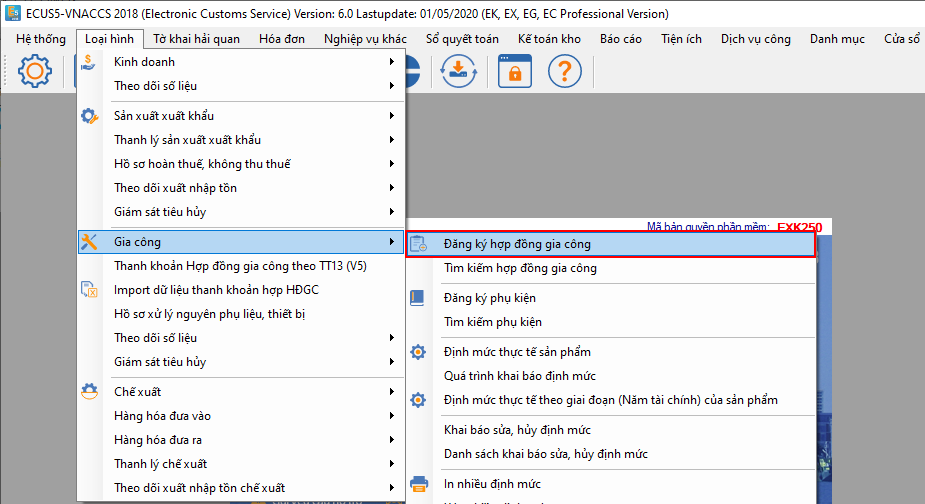
- Registration of a processing contract (initial):
- Before importing the first shipment for a processing contract, the enterprise must register the contract with the customs authority (the Customs Sub-department where the enterprise is headquartered or where the raw materials and supplies are stored).
- Registration is typically carried out via an electronic system.
- Filing the import declaration:
- Use customs declaration softwares like ECUS, Thai Son, etc.. for creating import declarations Thai Son, v.v.) để lập tờ khai nhập khẩu.
- Select the appropriate type (usually E21 – import of raw materials and supplies for the production of goods for export, or another code if customs has specific regulations for processing).
- Fill in all required information: processing contract number, tax identification number, type code, goods details, value, and tax rate (typically 0% for processing goods, though all tax-related fields must still be fully declared).
- Transmit the declaration to the VNACCS/VCIS system.
- Receive results: The system will automatically assign categories (green, yellow, red).
- Green category: Thông quan ngay, doanh nghiệp in tờ khai và đưa hàng ra khỏi khu vực giám sát hải quan.
- Yellow: Customs authorities inspect paper documentation. Enterprises submit the documents prepared under Section I to customs for inspection.
- Red: Customs authorities conduct a physical inspection of the goods and a review of the paper documentation. The enterprise cooperates with Customs during the inspection process.
- Customs clearance and release of goods: Upon completion of any required inspection procedures, customs authorities will issue a customs clearance decision, and the enterprise may transport the goods to its warehouse.
B. For the export of processed products:
- Export customs declaration:
- Use customs declaration software to prepare the export declaration.
- Select code B50 (export of processed goods).
- Fill in all required information: toll manufacturing contract number, tax identification number, type code, product details, value, etc.
- Transmit the declaration to the VNACCS/VCIS system.
- Receive results: Same as import.
- Green category: Customs clear.
- Yellow: Customs check the documentation.
- Red: Customs authorities conduct a physical inspection of the goods and verify the paper documentation.
- Customs clear and release: Upon completion of inspection procedures (if any), customs will grant clearance, and the enterprise may export the goods.
III. Settlement and liquidation of the processing contract:
This is a mandatory and extremely important step for export processing operations.
- Prepare the final settlement report:
- Periodically (usually annually or in accordance with the contract term), the enterprise must prepare a finalization report on the usage of imported raw materials and supplies for the production of goods for export processing.
- This report requires a reconciliation of the quantity of imported raw materials, the quantity consumed based on established norms, inventory levels, the quantity of exported products, and the quantity of scrap and defective products (if any).
- Submit the final settlement report to the customs authority:
- The enterprise submits the final settlement report to the Customs Sub-department where the processing contract was registered.
- The submission of finalization reports is typically carried out via an electronic system.
- Post-clearance audit (if applicable):
- Customs authorities may conduct post-clearance audits at the enterprise's premises to reconcile finalization report data with the enterprise's actual accounting records and supporting documents.
- The objective is to ensure that the enterprise has used the raw materials for their intended purpose and has not engaged in tax fraud.
- Handling of scrap and defective products:
- For scrap and defective products generated during the processing stage, enterprises must have a disposal plan (re-export, destruction, or domestic sale).
- Depending on the chosen handling method, there will be associated customs procedures and tax obligations.
Important note:
- Compliance: Enterprises must strictly comply with legal regulations regarding customs and taxation, particularly those concerning norms and finalization reports.
- Record-keeping system: Establish and maintain a comprehensive and clear system of accounting records and documentation to track the receipt, issuance, and inventory of raw materials, supplies, and processed finished goods.
- Norms: Norms must be established in a scientific and accurate manner, with a sound basis for justification upon request by customs authorities.
- Risks: Export processing is a high-risk activity if not strictly managed by the enterprise—particularly regarding the reconciliation of raw materials and supplies, as well as the potential for retroactive tax assessments.
- Cập nhật quy định: Các quy định về hải quan thường xuyên thay đổi, doanh nghiệp cần liên tục cập nhật thông tin từ Tổng cục Hải quan, Cục Hải quan địa phương và các văn bản pháp luật liên quan.
Hy vọng những thông tin chi tiết này sẽ giúp bạn hình dung rõ ràng hơn về quy trình khai báo hải quan cho loại hình gia công xuất khẩu. Nếu có bất kỳ thắc mắc nào khác, đừng ngần ngại liên hệ với chúng tôi tại đây để được tư vấn kỹ hơn.